
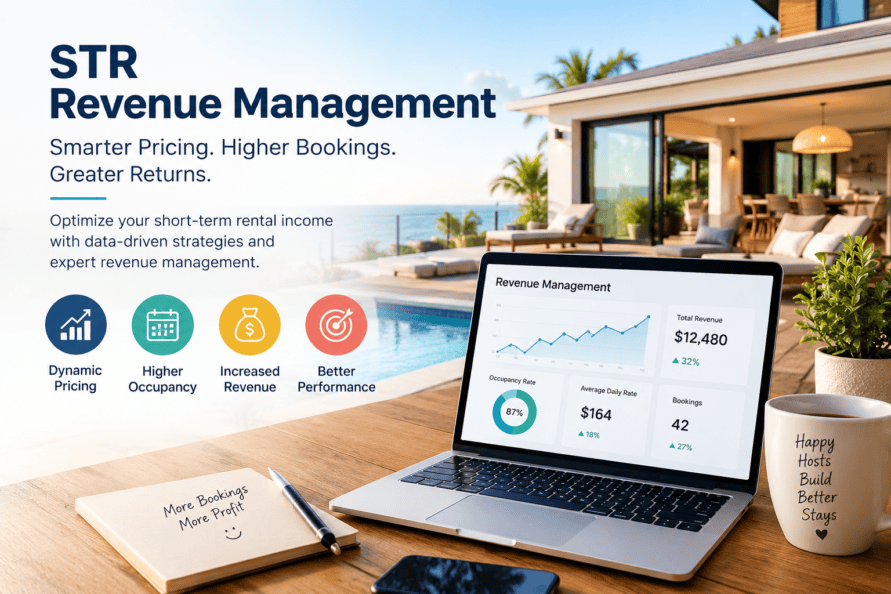
STR revenue management is the disciplined process of deciding what to charge, when to adjust the price, and how to judge whether a short-term rental is performing well. It connects pricing with occupancy, operating costs, guest expectations, local rules, and the owner’s goals—not just busy weekends.
Start with the three numbers that tell the story
Occupancy is the share of available nights that are booked. Average daily rate (ADR) is the average nightly revenue from booked nights. A third view—revenue per available night—puts the two together by dividing booked-night revenue by all nights you made available.
Consider a simple 30-night month. Twenty nights at $180 produces $3,600, with 66.7% occupancy and a $180 ADR. Twenty-four nights at $150 also produces $3,600, with 80% occupancy and a $150 ADR. Neither result is automatically better. The right choice depends on cleaning and turnover costs, minimum stays, owner-blocked dates, seasonality, cash-flow needs, and how much work each booking creates.
That is why “keep occupancy as high as possible” is not a complete strategy. A discount that fills dates below a sensible contribution margin can create activity without creating healthy results.
Price for the stay, not just the date
A thoughtful pricing review looks at the home’s real offer: location, capacity, amenities, condition, parking, booking lead time, length of stay, and date-specific demand. Research on short-term-rental pricing found that property capacity, equipment, and surrounding-area characteristics were associated with starting nightly prices, but its Madrid data and historical period are not a universal formula. Read the peer-reviewed study
In practice, that means using comparable homes as context rather than copying a competitor’s number. A two-bedroom home with a different layout, review history, parking situation, or cancellation pattern may need a different price even when it is nearby. Prices should be revisited as booking pace and market conditions change, not changed randomly every day.
Ethical pricing is clear, consistent, and explainable
Revenue management should never mean misleading guests or using pricing to exclude people unfairly. Keep the listing accurate, show required charges clearly, and avoid creating a low headline rate that becomes materially different at checkout. Do not promise a result that the data cannot support.
Owners should also ask how pricing decisions are made. A responsible process can explain a change—such as a holiday, short booking window, reservation gap, or slower booking pace—without pretending that any algorithm knows the future.
What a useful owner report should show
A monthly report should do more than display gross booking revenue. Ask for a calendar view of available, booked, owner-blocked, and maintenance nights. Then ask for occupancy, ADR, booking revenue, cleaning or other pass-through amounts, platform fees, management fees, refunds, cancellations, and the resulting owner-level net figure, with each item labeled.
It should also show booking pace and forward-looking reservations separately from completed stays. A booking made today for next month is not revenue already realized. Helpful context includes lead time, average stay length, booking channel, cancellations, and calendar changes. If a price changed, the report should say what and why.
Before comparing months, ask whether the denominator stayed consistent. Removing owner blocks from “available” nights can make occupancy look stronger; leaving unbookable maintenance dates in the denominator can make it look weaker. Consistent definitions matter more than a polished dashboard.
Compliance belongs before optimization
Pricing cannot fix an operation that is not allowed to run. Rules vary by city, property type, and stay structure, so owners should verify requirements with the relevant government office and qualified advisers rather than treating this article as legal or tax advice. For example, the City of San Diego says short-term residential occupancies require an STRO license, with different license tiers. Los Angeles City Planning says eligible home-sharing hosts must register and display a registration number on listings. Confirm the current rules before setting a calendar or advertising a home.
A practical next conversation
Ask three questions: What counts as an available night? Which metric defines success? What will we do when occupancy and ADR move in opposite directions? Clear answers turn revenue management into an owner-controlled operating plan.
Here2HostYou describes its approach as “Elevated Stays, Thoughtfully Managed,” with short-term-rental management from listings to guest support, long-term and insurance stays, and owner partnerships built around transparent reporting and strategic guidance. Its homepage lists homes in San Diego, Los Angeles, and other locations. Learn more about Here2HostYou and explore whether its owner partnership model fits your property.