Here2Host

How Professional Airbnb Property Management Helps You Maximize Rental Success

Owning a vacation rental can be a rewarding investment, but managing it successfully requires time, organization, and consistent attention to detail. From responding to guest inquiries and coordinating check-ins to maintaining the property and handling bookings, short-term rental hosting involves many responsibilities. For property owners who want to earn rental income without managing every task themselves, professional property management can make a significant difference.

Choosing the Best Airbnb Property Management service can help property owners create a better guest experience while keeping their rental operations organized. With the right support, owners can spend less time dealing with daily responsibilities and more time focusing on their personal goals, other investments, or simply enjoying the benefits of owning a vacation property.

Why Airbnb Property Management Matters

Running a successful Airbnb rental involves much more than publishing a listing online. Guests expect accurate property descriptions, clean accommodations, smooth check-ins, and quick responses when they have questions. Even small issues can affect guest satisfaction and influence future reviews.

Professional property management helps bring these responsibilities together under one organized process. Depending on the services offered, a property manager may oversee guest communication, booking coordination, cleaning schedules, maintenance requests, and listing updates.

Having reliable support can also help owners maintain consistency, especially when they live far away from their rental property or manage multiple homes. A well-organized rental is easier to operate and can provide guests with a more comfortable and dependable experience.

Improve Your Listing and Attract More Guests

A strong online listing is essential for attracting potential guests. Travelers often compare several properties before deciding where to stay, so clear information and appealing presentation matter.

Professional management may include improving property descriptions, organizing high-quality photography, highlighting useful amenities, and keeping availability calendars accurate. Descriptions should explain what makes the property special while providing honest information about its location, features, and suitability for different travelers.

Pricing is another important factor. Rental demand can change depending on the season, local events, holidays, and competing accommodations. A property manager may review market conditions and adjust nightly rates accordingly. Although pricing strategies cannot guarantee higher bookings or profits, thoughtful adjustments can help owners remain competitive.

Deliver a Better Guest Experience

Guest satisfaction plays an important role in building a successful short-term rental business. From the first inquiry to checkout, travelers appreciate clear communication and straightforward instructions.

A property management team can coordinate check-in details, answer common questions, and help resolve concerns during a guest’s stay. Prompt communication can reduce confusion and make visitors feel more confident about their accommodation.

Cleanliness is equally important. Coordinating professional cleaning between reservations helps ensure that the property is ready for each arrival. Regular inspections can also identify maintenance concerns before they become larger problems.

When guests enjoy a comfortable and well-organized stay, they may be more likely to leave positive reviews or consider booking the property again.

Protect Your Property Through Regular Maintenance

Maintaining a vacation rental requires ongoing attention. Appliances, plumbing, electrical fixtures, furniture, and other household features need periodic inspection to remain in good working condition.

Property management services may coordinate routine maintenance, arrange repairs, and communicate with local service providers when issues arise. Owners should clarify which maintenance tasks are included in their agreement and whether additional repairs require separate approval or fees.

Preventive maintenance can help reduce unexpected disruptions and protect the property’s long-term condition. It also helps ensure that guests have access to the amenities and facilities described in the listing.

Save Time With Professional Support

Managing a short-term rental independently can become overwhelming, particularly when bookings overlap or guests need assistance outside regular business hours. Property owners may also struggle to balance hosting responsibilities with work, family commitments, and other investments.

Working with a management company such as Here2HostYou can help simplify the process by providing support with the responsibilities covered under its service agreement. Before choosing a provider, owners should compare management fees, included services, communication practices, reporting procedures, and contract terms.

The goal is to find a partner whose approach matches your property, budget, and expectations.

Choose the Right Airbnb Property Management Partner

Not every property management company offers the same services, so it is important to evaluate your options carefully. Ask about the company’s experience with similar properties, guest communication procedures, cleaning standards, pricing approach, and maintenance coordination.

You should also understand how rental income and expenses are reported, who approves repairs, and how emergencies are handled. Reading reviews and requesting a clear written agreement can help you make an informed decision.

A trustworthy management partner should communicate transparently, explain its responsibilities, and provide realistic expectations rather than promising guaranteed occupancy or profits.

Conclusion

Successful vacation rental ownership depends on providing a positive guest experience while managing daily operations efficiently. From listing optimization and booking coordination to cleaning and maintenance, professional support can help make hosting more manageable.

By carefully evaluating your options and choosing a service that aligns with your needs, you can build a more organized rental operation and create a welcoming experience for travelers. The right management approach can help you protect your investment, reduce everyday stress, and work toward your long-term rental goals.

Best Airbnb Property Management: A Practical Framework for Choosing a Partner

Searching for the best Airbnb property management partner is less about finding a universal winner and more about finding an operating fit for your home, market, and preferred level of involvement. Compare how each company handles the work that protects the guest experience and keeps you informed as the owner.

1. Platform experience: can they run the listing responsibly?

Ask who owns the Airbnb account, who can edit the listing, and how changes to photos, amenities, house rules, availability, and pricing are documented. Confirm whether you retain access to the account and property information if the relationship ends.

Airbnb’s published ground rules cover listing accuracy, honoring reservations and refunds, timely communication, and cleanliness. Airbnb also says hosts must be authorized to host and comply with applicable laws (Airbnb’s host ground rules; Airbnb’s host expectations). Ask the manager to explain its review and escalation process, not just promise more bookings.

Ask: Who checks that the listing matches the home today? How are booking changes approved? What happens when the platform flags an issue?

2. Guest service: who owns the conversation?

Good guest support is a process, not a vague promise of “24/7 service.” Ask who monitors pre-arrival questions, check-in problems, during-stay issues, and checkout follow-up. Look for clear handoffs, documented communication, and a human escalation path when a guest reports a broken amenity, cleanliness concern, or safety issue.

Airbnb expects hosts or co-hosts to be available for guest inquiries and unexpected issues, with faster attention especially important near check-in and during a stay (Airbnb’s communication guidance).

3. Listing operations: what happens between reservations?

Ask how the company reviews photos and descriptions, manages calendars, updates minimum-stay settings, and confirms that advertised amenities remain available. Request a sample owner report before signing. Clarify the workflow for cancellations, refunds, review responses, and platform-compliant guest screening. You should know which decisions are routine, which require your approval, and when you will be notified.

4. Maintenance: how do small problems stay small?

Ask what happens after every checkout. Is there a documented inspection? Are findings photographed? Who authorizes a repair, and what spending limit requires your approval? How are recurring issues tracked? Also ask for the after-hours plan for a lockout, leak, heating or cooling failure, or other urgent concern. A trustworthy manager will explain the process and the record you receive afterward.

5. Owner transparency: can you follow the story of the property?

Compare reporting before comparing management fees. A useful report should help you reconcile reservations, adjustments, refunds, platform charges, cleaning or maintenance items, and owner payouts. Clarify the difference between gross booking revenue, expenses, and the amount paid to you. Ask about receipts, approval thresholds, contract length, termination terms, and who controls listing content and guest records.

Check local fit before you sign

Short-term-rental rules vary by city and can change. In the City of San Diego, official STRO information says hosts need an active Transient Occupancy Tax certificate and current compliance with Rental Unit Business Tax requirements (City of San Diego STRO). Los Angeles City Planning says home-sharing hosts must register and display a registration number on listings; its FAQ also describes primary-residence eligibility and annual renewal (Los Angeles Home-Sharing FAQ). These are examples, not a substitute for checking the official rules for your property. This is not legal or tax advice; confirm requirements with the relevant authority and your adviser.

Turn the conversations into a fair comparison

Give each candidate the same brief about your property and request written answers to the five sections above. Score clarity, documentation, communication, local familiarity, and owner visibility—not just projected income. Then review the agreement line by line, including responsibilities, approvals, access, reporting, and the exit process.

Here2HostYou describes its approach as “Elevated Stays, Thoughtfully Managed.” Its homepage says it manages short-term rentals from listings to guest support, offers long-term and insurance stays, and works with owners through transparent reporting and strategic guidance. The site shows homes in San Diego, Los Angeles, and other locations (Here2HostYou). Those stated services may be relevant, but they are not proof that any manager is right for every property.

Ready to compare your options? Learn more about Here2HostYou and use this framework to decide whether its approach fits your property and expectations.

Airbnb Revenue Management Services: A Practical Owner’s Guide to Pricing With Purpose

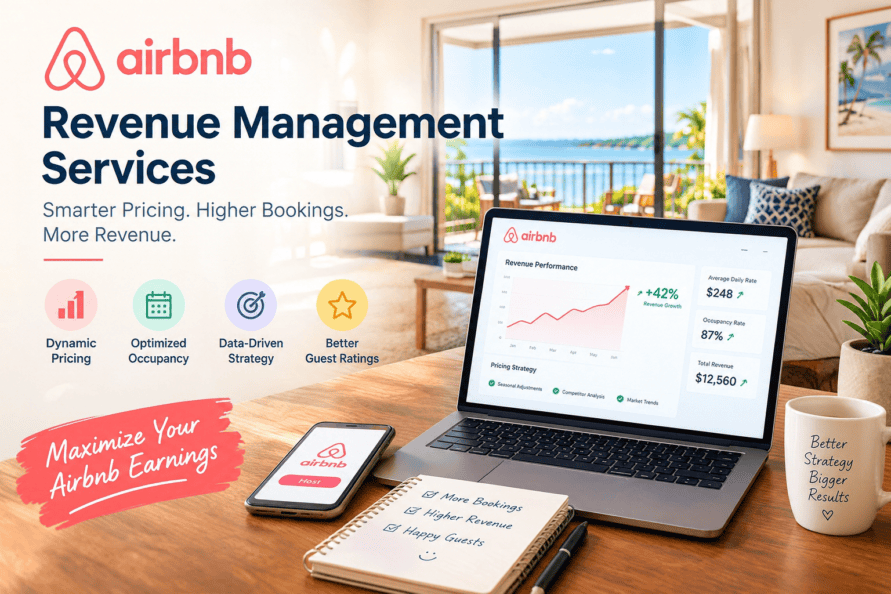
Airbnb revenue management services are not simply a promise to charge more per night. For a rental owner, revenue management is a disciplined operating process: set a sensible base price, adjust it as demand changes, protect availability, watch booking pace, account for seasonality, and explain the results in clear owner reports. The goal is better-informed decisions—not a guaranteed uplift.

That distinction matters because a calendar can look busy while leaving nights unsold. A responsible manager connects decisions to the owner’s goals, constraints, and booking calendar.

What a revenue management service should manage

Pricing starts with a defensible base rate for the home, location, quality, capacity, and costs. Rates can then change by day, lead time, length of stay, and demand. Airbnb’s Smart Pricing tool says it uses hundreds of factors about a listing and its area, lets hosts set a minimum and maximum, and allows date-specific overrides (Airbnb Help Center). A service should explain when it follows automation and when a human decision is appropriate.

Availability is the other half of the equation. Pricing an unavailable night, or opening dates that conflict with maintenance or an owner stay, creates problems. Revenue management can include stay limits, check-in and checkout patterns, and decisions about when to open future dates. Airbnb’s professional rule-sets support seasonal adjustments, length-of-stay discounts, last-minute or early-bird discounts, trip-length requirements, and check-in or checkout requirements (Airbnb Help Center). The rules still need to fit the property and avoid unwanted gaps.

Booking pace is the calendar’s early signal. A manager can compare how far ahead reservations arrive with past patterns and current open nights. A slow date might call for a targeted rate or stay-length change; earlier-than-expected demand might justify protecting dates instead of discounting too soon. The important practice is documenting what changed and why.

Seasonality is more than a busy month

Seasonality affects more than the headline rate. It can change the mix of short and longer stays, the value of weekends, cleaning turns, and practical owner-blocked time. A thoughtful plan maps demand periods, then revisits those assumptions as booking pace develops.

For a coastal home in Southern California, the relevant pattern may not match another property nearby. A manager should consider location, amenities, calendar restrictions, and owner priorities rather than apply one template. If the home can also serve long-term or insurance stays, those opportunities belong in the availability conversation after the owner and manager agree on the tradeoffs.

Reporting turns rate changes into owner decisions

A useful owner report should answer more than “What did we earn?” It should make the operating logic visible. Ask whether it shows:

  • booked and available nights, plus reservations added and how far ahead they booked;
  • average nightly rate alongside occupancy, rather than treating either as the whole story;
  • owner blocks, maintenance closures, cancellations, and other availability changes;
  • notable pricing or minimum-stay changes, with a plain-language reason; and
  • upcoming gaps, seasonality assumptions, and decisions needing owner input.

No single metric proves that a strategy worked. A higher rate can coincide with fewer booked nights, while fuller occupancy can come from discounts that do not suit the owner’s objectives. Reporting should help evaluate the tradeoff.

Compliance belongs in the operating checklist

Local rules can affect whether a property may be offered, how many nights are available, or what a listing must show. Rules vary and can change, so confirm them with the relevant government office and obtain professional legal or tax advice when needed. For example, the City of San Diego says a license is required for short-term residential occupancy of a dwelling unit or part of one for less than a month within the city. Los Angeles says hosts engaging in short-term rentals must register with the City Planning Department and post the registration number on advertisements, with additional housing restrictions (Los Angeles Housing Department). A revenue plan that ignores compliance is not reliable.

Questions to ask before choosing a service

Ask how often rates and availability are reviewed, which decisions remain yours, how owner blocks and maintenance are handled, and whether long-term or insurance-stay possibilities are considered. Request a sample report with assumptions, calendar changes, and explanations—not just a top-line total. Be cautious of guarantees, unexplained benchmarks, or one-size-fits-all strategies.

Here2HostYou describes its approach as “Elevated Stays, Thoughtfully Managed.” Its homepage says the company manages short-term rentals from listings through guest support, offers long-term and insurance stays, and builds owner partnerships around transparent reporting and strategic guidance. To learn how that approach could fit your property, visit Here2HostYou.

STR Revenue Management in Plain English: A Practical Guide for Rental Owners

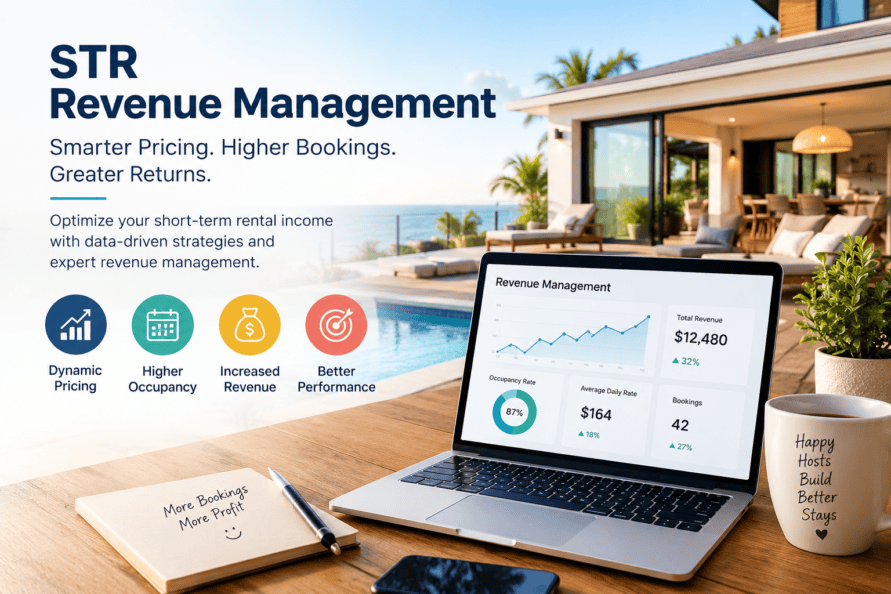
STR revenue management is the disciplined process of deciding what to charge, when to adjust the price, and how to judge whether a short-term rental is performing well. It connects pricing with occupancy, operating costs, guest expectations, local rules, and the owner’s goals—not just busy weekends.

Start with the three numbers that tell the story

Occupancy is the share of available nights that are booked. Average daily rate (ADR) is the average nightly revenue from booked nights. A third view—revenue per available night—puts the two together by dividing booked-night revenue by all nights you made available.

Consider a simple 30-night month. Twenty nights at $180 produces $3,600, with 66.7% occupancy and a $180 ADR. Twenty-four nights at $150 also produces $3,600, with 80% occupancy and a $150 ADR. Neither result is automatically better. The right choice depends on cleaning and turnover costs, minimum stays, owner-blocked dates, seasonality, cash-flow needs, and how much work each booking creates.

That is why “keep occupancy as high as possible” is not a complete strategy. A discount that fills dates below a sensible contribution margin can create activity without creating healthy results.

Price for the stay, not just the date

A thoughtful pricing review looks at the home’s real offer: location, capacity, amenities, condition, parking, booking lead time, length of stay, and date-specific demand. Research on short-term-rental pricing found that property capacity, equipment, and surrounding-area characteristics were associated with starting nightly prices, but its Madrid data and historical period are not a universal formula. Read the peer-reviewed study

In practice, that means using comparable homes as context rather than copying a competitor’s number. A two-bedroom home with a different layout, review history, parking situation, or cancellation pattern may need a different price even when it is nearby. Prices should be revisited as booking pace and market conditions change, not changed randomly every day.

Ethical pricing is clear, consistent, and explainable

Revenue management should never mean misleading guests or using pricing to exclude people unfairly. Keep the listing accurate, show required charges clearly, and avoid creating a low headline rate that becomes materially different at checkout. Do not promise a result that the data cannot support.

Owners should also ask how pricing decisions are made. A responsible process can explain a change—such as a holiday, short booking window, reservation gap, or slower booking pace—without pretending that any algorithm knows the future.

What a useful owner report should show

A monthly report should do more than display gross booking revenue. Ask for a calendar view of available, booked, owner-blocked, and maintenance nights. Then ask for occupancy, ADR, booking revenue, cleaning or other pass-through amounts, platform fees, management fees, refunds, cancellations, and the resulting owner-level net figure, with each item labeled.

It should also show booking pace and forward-looking reservations separately from completed stays. A booking made today for next month is not revenue already realized. Helpful context includes lead time, average stay length, booking channel, cancellations, and calendar changes. If a price changed, the report should say what and why.

Before comparing months, ask whether the denominator stayed consistent. Removing owner blocks from “available” nights can make occupancy look stronger; leaving unbookable maintenance dates in the denominator can make it look weaker. Consistent definitions matter more than a polished dashboard.

Compliance belongs before optimization

Pricing cannot fix an operation that is not allowed to run. Rules vary by city, property type, and stay structure, so owners should verify requirements with the relevant government office and qualified advisers rather than treating this article as legal or tax advice. For example, the City of San Diego says short-term residential occupancies require an STRO license, with different license tiers. Los Angeles City Planning says eligible home-sharing hosts must register and display a registration number on listings. Confirm the current rules before setting a calendar or advertising a home.

A practical next conversation

Ask three questions: What counts as an available night? Which metric defines success? What will we do when occupancy and ADR move in opposite directions? Clear answers turn revenue management into an owner-controlled operating plan.

Here2HostYou describes its approach as “Elevated Stays, Thoughtfully Managed,” with short-term-rental management from listings to guest support, long-term and insurance stays, and owner partnerships built around transparent reporting and strategic guidance. Its homepage lists homes in San Diego, Los Angeles, and other locations. Learn more about Here2HostYou and explore whether its owner partnership model fits your property.

How to Maximize Airbnb Revenue: A Complete Guide by Here2Host

Running a short term rental can be one of the most rewarding ways to earn extra income, but many hosts leave money on the table simply because they do not know how to maximize Airbnb revenue effectively. At Here2Host, we work with property owners every day who want to turn their listings into consistent, high performing income streams. In this guide, we will walk you through proven strategies that can help you boost bookings, increase your nightly rate, and grow your overall Airbnb revenue without sacrificing guest satisfaction.

Why Maximizing Airbnb Revenue Matters

The short term rental market has become extremely competitive. With thousands of listings available in most cities, guests have endless options to choose from. If you want your property to stand out and generate real profit, you need a strategy that goes beyond simply listing your space and waiting for bookings. Learning how to maximize Airbnb revenue means optimizing every part of the guest journey, from the moment someone searches for a place to stay to the moment they leave a five star review.

Optimize Your Listing for Search

Airbnb’s search algorithm rewards listings that are complete, accurate, and engaging. To improve your visibility, make sure your title includes relevant keywords such as your location, property type, and unique selling points. Your description should be detailed, honest, and formatted for easy reading. High quality photos are also essential since listings with professional images tend to receive significantly more bookings. At Here2Host, we always recommend updating your listing regularly to keep it fresh in Airbnb’s search results.

Use Dynamic Pricing Strategies

One of the biggest mistakes new hosts make is setting a fixed nightly rate and never adjusting it. Demand for short term rentals fluctuates based on season, local events, holidays, and even day of the week. Using dynamic pricing tools allows you to automatically adjust your rates to match demand, helping you capture higher income during peak periods while staying competitive during slower months. This single change is often the fastest way to increase Airbnb revenue without any additional effort.

Improve Occupancy Rate

Revenue is not just about your nightly rate, it is also about how often your property is booked. Improving your occupancy rate can have a bigger impact on total income than raising prices alone. Consider offering discounts for longer stays, adjusting your minimum night requirements, and keeping your calendar flexible during low demand periods. A well optimized occupancy strategy paired with smart pricing is one of the most reliable ways to maximize Airbnb revenue over the long term.

Enhance the Guest Experience

Happy guests leave positive reviews, and positive reviews directly influence future bookings. Small touches like a welcome basket, clear check in instructions, fast responses to messages, and a spotless property can make a huge difference. Guests are also more likely to book again or recommend your listing to friends and family when they feel genuinely cared for. Here2Host believes that guest experience is not just a nice extra, it is a core part of any serious revenue strategy.

Invest in Professional Photography

Visual appeal plays a massive role in converting browsers into bookers. Listings with high quality, well lit, and thoughtfully composed photos consistently outperform those with average images. If your budget allows, hiring a professional photographer can pay for itself many times over through increased bookings and higher nightly rates.

Offer Add On Services

Many hosts overlook the potential of add on services such as early check in, late check out, airport pickup, or curated local experiences. These small extras not only improve guest satisfaction but also create additional revenue streams that add up over time. Offering flexible options gives guests more reasons to choose your property over a competitor’s.

Monitor Your Competitors

Understanding what similar listings in your area are charging and offering can give you valuable insight into where you stand. Regularly reviewing competitor pricing, amenities, and guest reviews helps you identify gaps you can fill and opportunities you may be missing. This kind of market awareness is essential if you want to consistently maximize Airbnb revenue rather than guessing at what works.

Reduce Operational Costs

Revenue growth is not only about earning more, it is also about keeping more of what you earn. Streamlining cleaning schedules, negotiating better rates with service providers, and automating repetitive tasks like messaging and check in instructions can significantly reduce your operational expenses. Lower costs combined with higher income means stronger overall profit margins.

Leverage Multiple Booking Platforms

While Airbnb is often the primary platform for short term rental hosts, listing your property on additional platforms can expand your reach and reduce vacancy periods. A multi platform approach ensures your calendar stays fuller throughout the year, which directly supports your goal of maximizing revenue.

Partner With Experts

Managing all of these moving parts on your own can be overwhelming, especially if you own multiple properties or have limited time. This is where working with a dedicated property management partner like Here2Host becomes valuable. Our team specializes in helping hosts implement pricing strategies, improve guest communication, optimize listings, and ultimately achieve stronger financial results from their properties.

Final Thoughts

Learning how to maximize Airbnb revenue is not about one single trick, it is about combining smart pricing, strong guest experiences, effective marketing, and efficient operations into one cohesive strategy. Whether you are a first time host or an experienced property owner looking to scale, small consistent improvements across every part of your hosting journey can lead to significant income growth over time.

At Here2Host, our mission is to help hosts like you unlock the full earning potential of your property. If you are ready to take your Airbnb income to the next level, our team is here to guide you every step of the way toward smarter, more profitable hosting.

How to Increase Airbnb Bookings: 11 Strategies That Actually Move the Needle

If your calendar has more empty nights than you’d like, you’re not alone, and you’re not stuck. Airbnb bookings respond predictably to a handful of levers. How your listing looks, how it’s priced, how fast you respond, and how consistent the guest experience is all matter. Get those right, and bookings follow.

Here’s what actually works in 2026, starting with the highest-impact changes. At Here2Host, we see the same handful of fixes turn slow calendars around for owners across San Diego, Los Angeles, and beyond, and none of them require a full listing overhaul.

1. Fix Your Photos First

Photos are the single biggest driver of click-through on Airbnb’s search results. Guests decide whether to open your listing in about two seconds, based almost entirely on the cover photo.

  • Shoot during the day with natural light, wide-angle where possible
  • Lead with your best room (usually the living space or the view), not the exterior
  • Show real scale, since guests want to see how many people actually fit at the dining table
  • Update seasonally; a photo of a sunny patio in December can feel stale

If your listing photos are more than two years old or were taken on a phone in artificial light, this is the first thing to fix, before touching price or description.

2. Rewrite Your Description Around Guest Outcomes

Most listing descriptions read like a features list, such as “3 bedrooms, 2 baths, full kitchen.” That’s necessary but not persuasive. Rewrite the opening two sentences around what the guest actually gets, whether that’s a quiet work-from-home week, a walkable weekend with the family, or a private retreat after a beach day.

Put practical details (parking, check-in process, house rules) toward the bottom. Lead with the experience.

3. Price Dynamically, Not Statically

A flat nightly rate is one of the most common reasons a calendar sits empty. Demand shifts by day of week, season, and local events, so your pricing should too. If you’re managing pricing manually, review it weekly against the following.

  • Comparable listings in your immediate area
  • Local events (conventions, sports, festivals) that spike demand
  • Booking lead time, since properties with gaps 7-14 days out often need a price nudge

Owners who move from static to dynamic pricing typically see occupancy gains before they see rate increases, filling the calendar first, then optimizing rate. This is one of the first things Here2Host adjusts when we take over a new property, since it’s usually the fastest way to close calendar gaps.

4. Respond Fast, Because It’s a Ranking Factor

Airbnb’s search algorithm weights response rate and response time directly. A host who replies within an hour ranks higher, all else equal, than one who takes a day. Turn on instant book if you’re comfortable with it, and set up saved replies for common questions (check-in instructions, parking, early check-in requests) so nothing sits unanswered overnight.

5. Chase Reviews, Not Just Bookings

Reviews are the trust signal that converts browsers into bookers, and they influence Airbnb’s own ranking of your listing in search. A property with 4 reviews at 4.9 stars will often out-book one with 40 reviews at 4.5 stars, purely because recency and rating both matter.

  • Send a check-in message the morning after arrival to catch small issues before they become a bad review
  • Follow up post-stay with a short, specific ask for a review
  • Respond to every review, good or bad; future guests read the responses

6. Close the Gaps Between Bookings

A single-night gap between two bookings is dead inventory. Most guests won’t book a one-night stay sandwiched between others, and it fragments your calendar. Consider a short minimum-stay requirement, or run a small discount specifically to fill orphaned single nights before they go stale.

7. Offer Flexible Length-of-Stay Options

Weekly and monthly discounts do more than fill long gaps. They attract a different guest segment entirely, such as remote workers, relocation stays, and extended family visits, who book with far less price sensitivity per night than weekend travelers. If your calendar has slow stretches, test a 20-25% weekly discount before assuming the property just isn’t in demand.

8. List on More Than One Platform

Airbnb-only hosts leave bookings on the table. Listing the same property on Vrbo and Booking.com, synced through a channel manager to avoid double-booking, expands your reach to guests who search those platforms first and never see Airbnb-only inventory.

9. Highlight What Makes the Property Different

“Clean, comfortable, close to everything” describes half the listings in any market. What’s actually different about yours? Maybe it’s a hot tub, a rooftop view, walking distance to a specific landmark, or a pet-friendly policy that’s rare in the area. Lead with that in your title and first photo, not buried in the amenities list.

10. Adjust for Events, Not Just Seasons

Seasonal pricing catches the obvious swings, like summer and holidays. It misses the specific weekend a conference, concert, or sports event doubles demand in your area. Keep a running calendar of local events and adjust rates in the two-week window around them; this is often where the biggest single-booking revenue gains come from.

11. Consider Professional Management If You’re Stretched Thin

Every strategy above requires ongoing attention. Pricing has to be checked weekly, messages answered within the hour, and reviews followed up on individually. If you’re managing this alongside a full-time job or multiple properties, the gap between what you should be doing and what actually gets done is usually where bookings are lost. That’s the specific gap Here2Host co-hosting and full-service management closes, with a team actively managing pricing, guest response, and turnovers every day, rather than reactively.

FAQ

How long does it take to see results after making these changes?
Photo and description updates can shift click-through within days, since they affect how your listing performs in search results immediately. Pricing and review improvements tend to compound over 4-8 weeks as your booking pace and rating trend upward.

Is dynamic pricing worth it for a single property?
Yes. Even manually checking comparable listings weekly and adjusting for local events captures most of the benefit. Automated pricing tools help more as you add properties or have less time to check the market yourself.

What’s the single highest-impact change on this list?
For most underperforming listings, it’s photos and response time. Both affect how Airbnb’s search algorithm surfaces your property before a guest ever reads your description.