
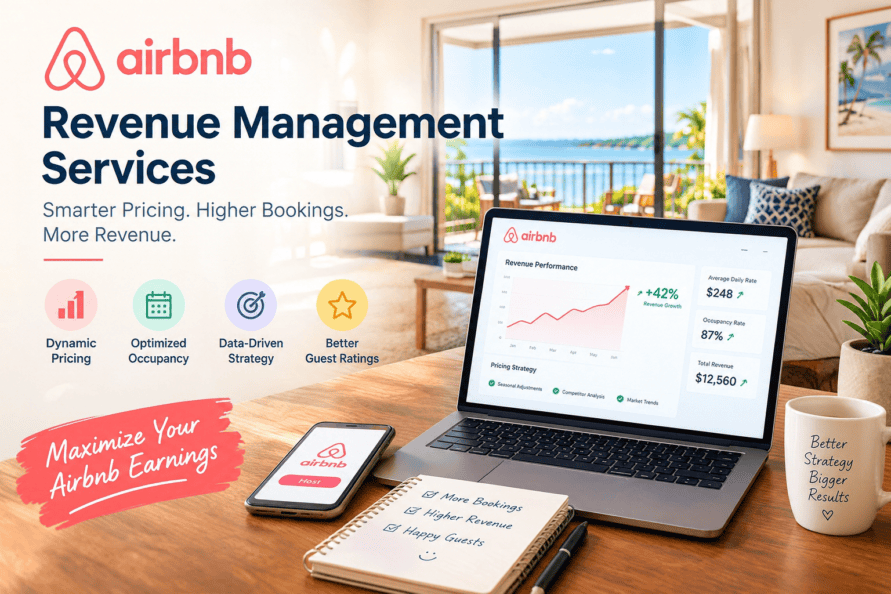
Airbnb revenue management services are not simply a promise to charge more per night. For a rental owner, revenue management is a disciplined operating process: set a sensible base price, adjust it as demand changes, protect availability, watch booking pace, account for seasonality, and explain the results in clear owner reports. The goal is better-informed decisions—not a guaranteed uplift.
That distinction matters because a calendar can look busy while leaving nights unsold. A responsible manager connects decisions to the owner’s goals, constraints, and booking calendar.
What a revenue management service should manage
Pricing starts with a defensible base rate for the home, location, quality, capacity, and costs. Rates can then change by day, lead time, length of stay, and demand. Airbnb’s Smart Pricing tool says it uses hundreds of factors about a listing and its area, lets hosts set a minimum and maximum, and allows date-specific overrides (Airbnb Help Center). A service should explain when it follows automation and when a human decision is appropriate.
Availability is the other half of the equation. Pricing an unavailable night, or opening dates that conflict with maintenance or an owner stay, creates problems. Revenue management can include stay limits, check-in and checkout patterns, and decisions about when to open future dates. Airbnb’s professional rule-sets support seasonal adjustments, length-of-stay discounts, last-minute or early-bird discounts, trip-length requirements, and check-in or checkout requirements (Airbnb Help Center). The rules still need to fit the property and avoid unwanted gaps.
Booking pace is the calendar’s early signal. A manager can compare how far ahead reservations arrive with past patterns and current open nights. A slow date might call for a targeted rate or stay-length change; earlier-than-expected demand might justify protecting dates instead of discounting too soon. The important practice is documenting what changed and why.
Seasonality is more than a busy month
Seasonality affects more than the headline rate. It can change the mix of short and longer stays, the value of weekends, cleaning turns, and practical owner-blocked time. A thoughtful plan maps demand periods, then revisits those assumptions as booking pace develops.
For a coastal home in Southern California, the relevant pattern may not match another property nearby. A manager should consider location, amenities, calendar restrictions, and owner priorities rather than apply one template. If the home can also serve long-term or insurance stays, those opportunities belong in the availability conversation after the owner and manager agree on the tradeoffs.
Reporting turns rate changes into owner decisions
A useful owner report should answer more than “What did we earn?” It should make the operating logic visible. Ask whether it shows:
- booked and available nights, plus reservations added and how far ahead they booked;
- average nightly rate alongside occupancy, rather than treating either as the whole story;
- owner blocks, maintenance closures, cancellations, and other availability changes;
- notable pricing or minimum-stay changes, with a plain-language reason; and
- upcoming gaps, seasonality assumptions, and decisions needing owner input.
No single metric proves that a strategy worked. A higher rate can coincide with fewer booked nights, while fuller occupancy can come from discounts that do not suit the owner’s objectives. Reporting should help evaluate the tradeoff.
Compliance belongs in the operating checklist
Local rules can affect whether a property may be offered, how many nights are available, or what a listing must show. Rules vary and can change, so confirm them with the relevant government office and obtain professional legal or tax advice when needed. For example, the City of San Diego says a license is required for short-term residential occupancy of a dwelling unit or part of one for less than a month within the city. Los Angeles says hosts engaging in short-term rentals must register with the City Planning Department and post the registration number on advertisements, with additional housing restrictions (Los Angeles Housing Department). A revenue plan that ignores compliance is not reliable.
Questions to ask before choosing a service
Ask how often rates and availability are reviewed, which decisions remain yours, how owner blocks and maintenance are handled, and whether long-term or insurance-stay possibilities are considered. Request a sample report with assumptions, calendar changes, and explanations—not just a top-line total. Be cautious of guarantees, unexplained benchmarks, or one-size-fits-all strategies.
Here2HostYou describes its approach as “Elevated Stays, Thoughtfully Managed.” Its homepage says the company manages short-term rentals from listings through guest support, offers long-term and insurance stays, and builds owner partnerships around transparent reporting and strategic guidance. To learn how that approach could fit your property, visit Here2HostYou.